Find the right AI model for your Android device.
Measure your hardware. Predict inference with Meta AI. Benchmark locally. Compare results with real evidence.
A prototype built for the Meta Global AI Developer Hackathon — real on-device llama.cpp inference, never simulated numbers.
Demo video coming soon · Extended app demo coming soon · Full technical walkthrough coming soon
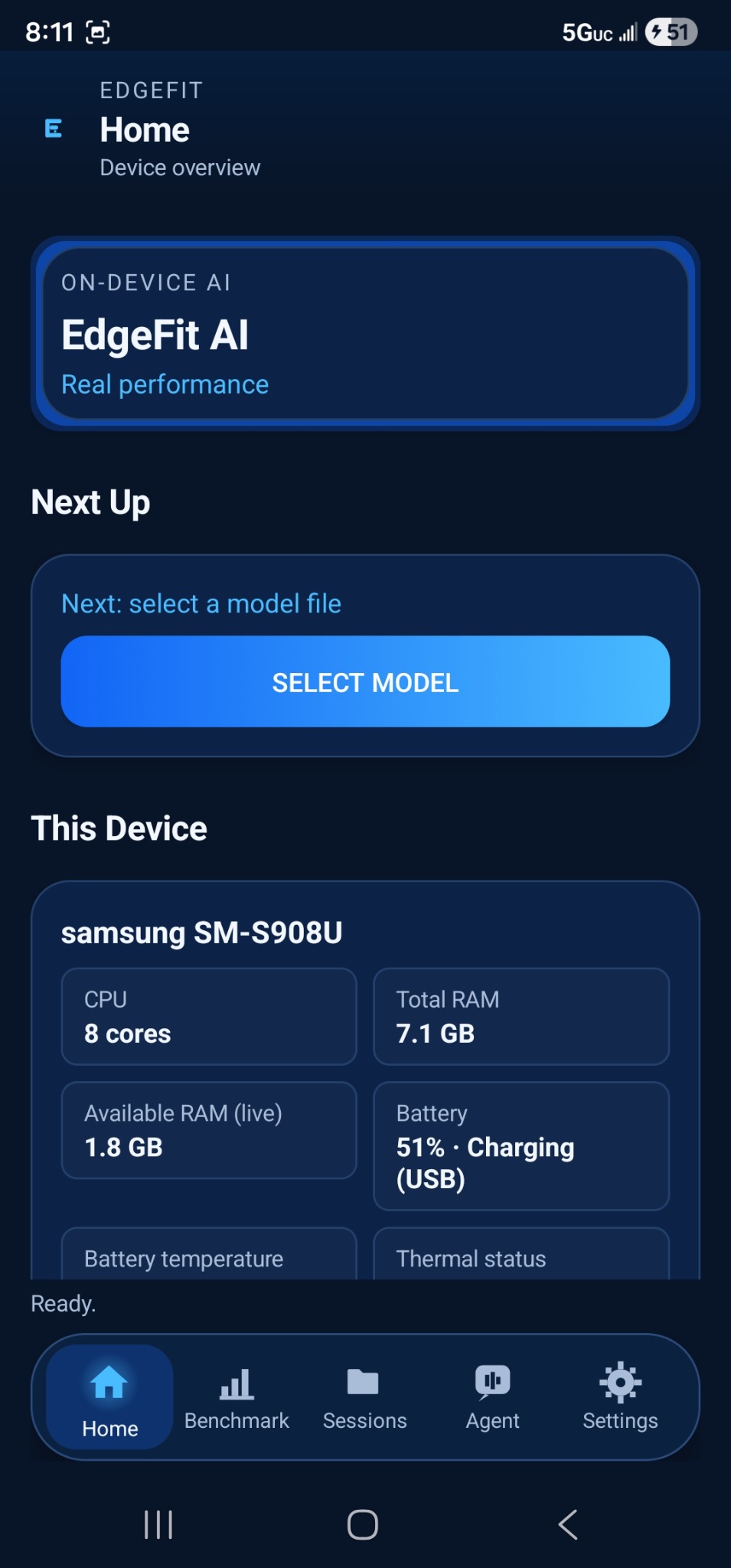
Captured on-device real screenshot — status bar and time are from the original capture.
Why Android? Hardware decides.
Android phones span an enormous range of CPUs, memory, storage, and thermal behavior. A model that flies on one phone may crawl on another — so EdgeFit starts from your measured hardware, not a leaderboard.
What EdgeFit does
Hardware-aware model selection
Profiles your phone and recommends compatible local LLM candidates with explicit compatibility estimates.
Real on-device benchmarking
Runs genuine llama.cpp inference on the phone and records measured throughput with thermal and memory conditions.
Meta Muse Spark predictions
Predicts inference speed before each measurement, with uncertainty — then the phone checks the answer.
Predicted vs measured
Every prediction is stored first; error is computed deterministically by the host, never narrated by the model.
Agentic optimization, gated
Bounded experiment proposals with explicit approve / reject and a fixed attempt budget. Nothing auto-runs.
Privacy-first sharing
Results stay on-device until you approve per-submission sharing. Global aggregates publish only above quorum.
Hardware-aware, like the app
The Android app starts from your device, not from a leaderboard. The same idea, on the web:
Example device profile DEMONSTRATION
Illustrative values for a phone of this class — not measured from your browser, which cannot see your hardware.
Try the model-fit check DEMONSTRATION
Pick a model size to see how EdgeFit reasons about fit before any benchmark runs. Sizes are public model facts; memory figures are illustrative. This is arithmetic, not a measurement — EdgeFit shows throughput only from real qualified runs.
The Android workflow
- 1Select a GGUF model file on the phone.
- 2Configure inference: context, threads, prediction length.
- 3Run a physical benchmark; results stay on-device.
- 4Review measured throughput per session.
- 5Optionally contribute with explicit consent (genuine uploads flowing under consent approval — see live counts on the dashboard).
App sections, as shipped: Home · Benchmark · Sessions · Agent · Settings.
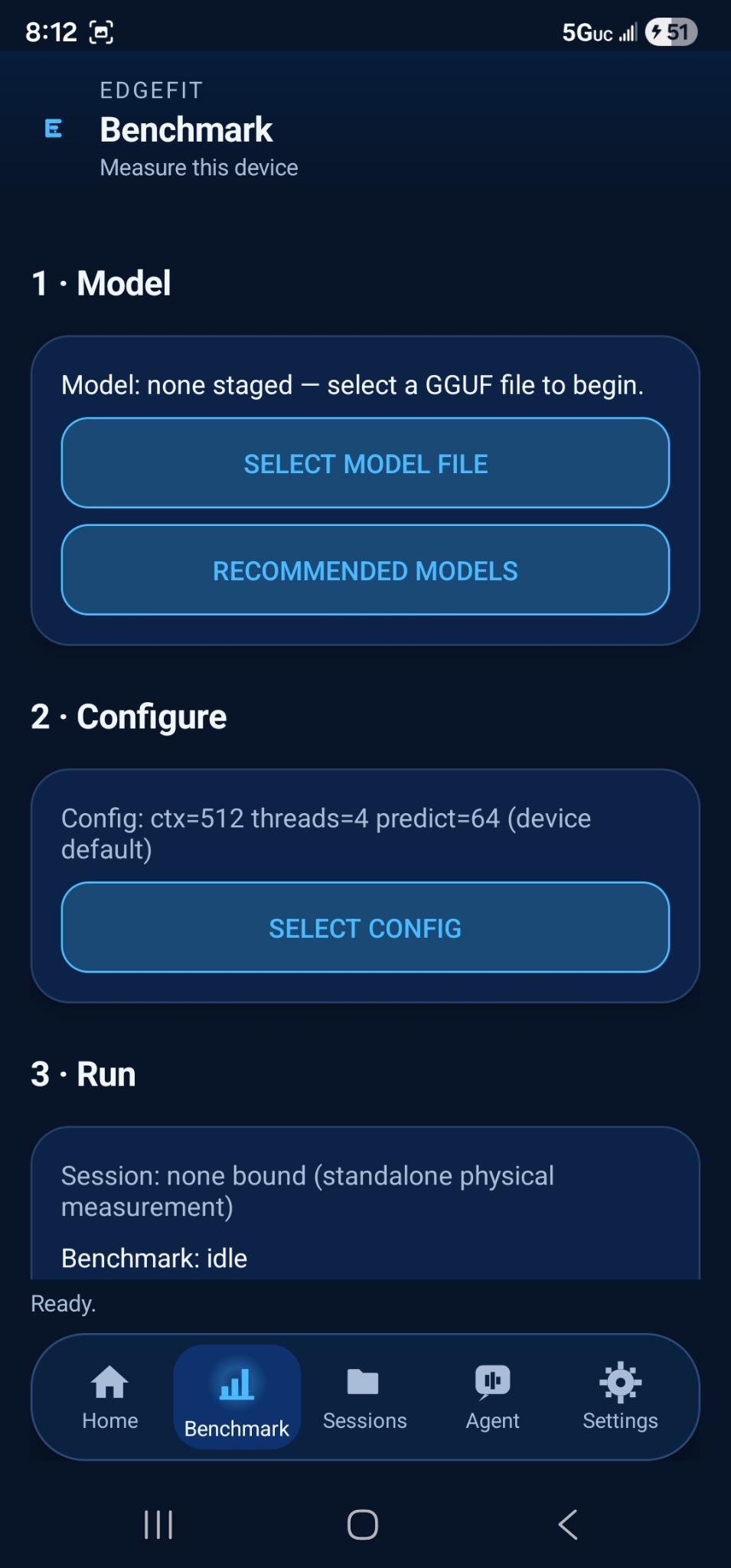
Captured on-device real screenshot — status bar and time are from the original capture.
Meta Muse Spark, honestly scoped
EdgeFit uses Meta's Muse Spark model to help analyze validated evidence: predictions before measurement, evidence-grounded follow-ups, and bounded optimization proposals — every one behind explicit human authorization. A validated tool request runs one fixed read-only query over local SQLite, and the model reasons over the returned rows. No live model outputs are shown on this site, and nothing here implies endorsement by Meta.
More than a static demo: technical evidence
Six-run physical study measured
Galaxy S22 Ultra, fixed workload: 4-thread median 16.52 tok/s vs 8-thread median 10.49 tok/s (n=3 each, exploratory, one device). Muse correctly abstained rather than guess beyond the evidence (fabricated-citation rate 0.0). Full artifacts, frozen manifests, and methodology live in the source repository, with reproducible offline test suites.
Global evidence, gated by proof
The long-term goal is a global network where only verified, consented, comparable phone measurements count. Genuine contributions are flowing (see live counts on the dashboard), but zero verified global aggregates are published yet. The evidence status page tracks exactly what exists and what publication requires.
Provenance honesty
All EdgeFit AI source in this repository is new work started October 26, 2026, for this hackathon. Honey LLM and BeeBench are pre-existing independent projects; EdgeFit does not reuse their code or present their results as its own.